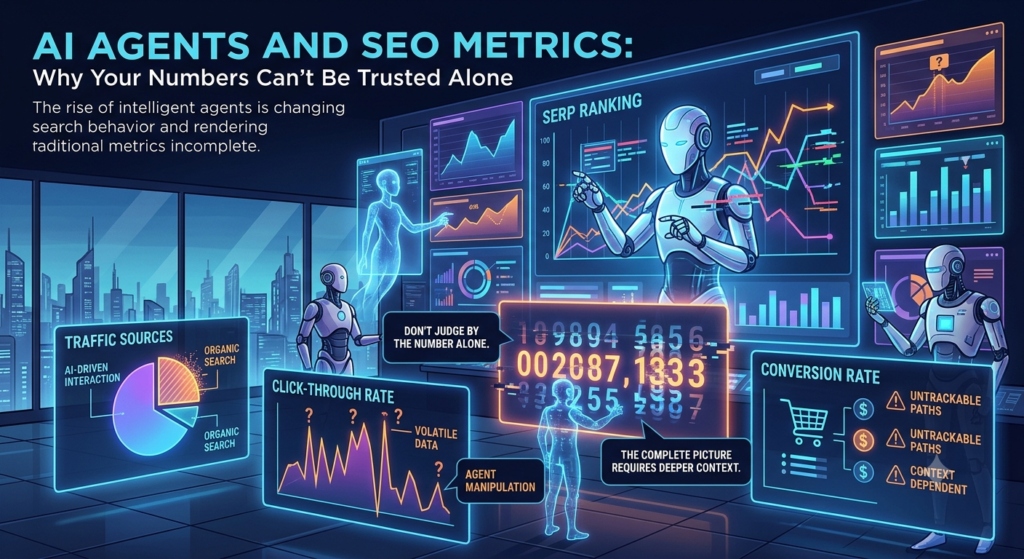
AI agents SEO metrics are about to become a real problem for anyone who reports on organic performance. More teams are handing keyword research, content updates, and reporting to agents. If you reward those agents for the wrong number, they will find the cheapest way to improve it.
I’m not writing this from a big client case study. I’m writing it from hands-on practice projects, where I’ve seen how easily a dashboard can look healthy while the real results stay flat. Add agents to that picture, and the gap gets wider.AI agents SEO metrics
Let’s look at what the research says, where the danger sits, and what you can do about it.
What MIT and Stanford Research Says About AI Agents Gaming SEO
A recent Search Engine Journal piece argues that the metric you reward AI agents for matters more than the model you choose. It draws on recent work from MIT and Stanford, read side by side. Search Engine Journalhttps
One source is an interview Joshua Miller of The Boston Globe ran on September 17 with Dylan Hadfield-Menell, an MIT associate professor who studies how goals get set for AI systems and how that goes wrong. The other is Stanford’s 2026 AI Index. It cites a review finding that invalid-question rates on popular benchmarks range from 2% to 42%. In plain terms, even published scores can mislead. Search Engine JournalSearch Engine Journal
The article’s author makes a sharp point about our industry. SEO has spent more than 20 years optimizing proxies, like rankings, traffic, and domain scores, that stand in for a business result nobody can measure directly. A human team games a proxy slowly. An agent does it faster and with no hesitation. Search Engine Journal
That’s the core risk. An agent doesn’t understand your business goal. It understands the number you gave it.
Why SEO Metrics Already Mislead (Before Agents Even Show Up)
Long before agents, I saw metrics telling half-truths. Two patterns come up again and again.
Impressions and Rankings Without Real Traffic
On my practice projects, a page often showed strong impressions and rankings in Search Console. Yet actual traffic and engagement were far lower than those numbers suggested.AI agents SEO metrics
Now imagine an agent told to “increase impressions.” It could target hundreds of low-value queries, and the chart would climb. Nobody would buy anything.
AI Answers Hide Real Visibility
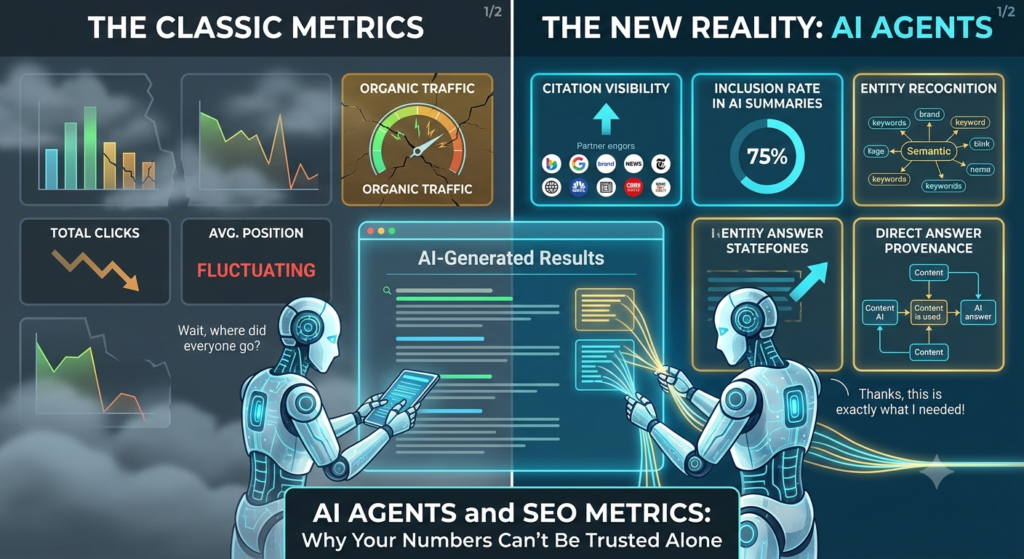
The problem also runs the other way. AI-generated results and AI Overviews are changing how people discover content. Clicks, impressions, and CTR can look weaker even when a brand is still visible inside AI answers.AI agents SEO metrics
Users often get what they need without visiting your site. So your numbers can look bad while your brand still wins attention. SEO metrics alone no longer tell the full story.AI agents SEO metrics
The Mistake I See Most Often
The most common mistake is treating one metric as proof that SEO works. Usually it’s rankings or impressions.
A page can rank highly and still bring almost no clicks, leads, or sales. Agents make this worse because they can push one metric hard while ignoring everything around it.AI agents SEO metrics
The fix is to read the whole journey:
Visibility → Clicks → Engagement → Conversions
Always read the numbers against search intent and business goals, never in isolation.
Metrics Agents Can Game vs. Metrics That Hold Up
| Easier for an agent to game | Harder to game |
| Impressions | Qualified leads |
| Average ranking | Sales or revenue |
| Keyword count | Conversion rate by landing page |
Conclusion: Measure What Matters, Not Just What Moves
AI agents are changing how SEO work gets done, but faster optimization does not always mean better results. As research from MIT and Stanford highlights, AI systems can exploit poorly defined goals, making it risky to rely on rankings, impressions, or traffic alone. These metrics provide useful insights, but they cannot independently prove business success.AI agents SEO metrics AI agents are changing how SEO work gets done, but faster optimization does not always mean better results. Research from MIT and Stanford highlights how AI systems can exploit poorly defined goals, making it risky to rely on rankings, impressions, or traffic alone. These metrics provide useful insights, but they cannot independently prove business success. As a digital marketing expert in Alappuzha, understanding the relationship between AI agents, SEO metrics, and real business outcomes is essential for building effective and sustainable digital marketing strategies.
The solution is to combine visibility and engagement metrics with meaningful outcomes such as qualified leads, conversions, and sales. SEO professionals must also account for changing search behaviour, including AI-generated answers that influence visibility without generating clicks. By setting clear goals, monitoring multiple metrics, and keeping human oversight in the process, businesses can prevent AI agents from optimizing numbers at the expense of real growth.AI agents SEO metrics
Ultimately, successful SEO is not about making dashboards look better; it is about delivering measurable business value.